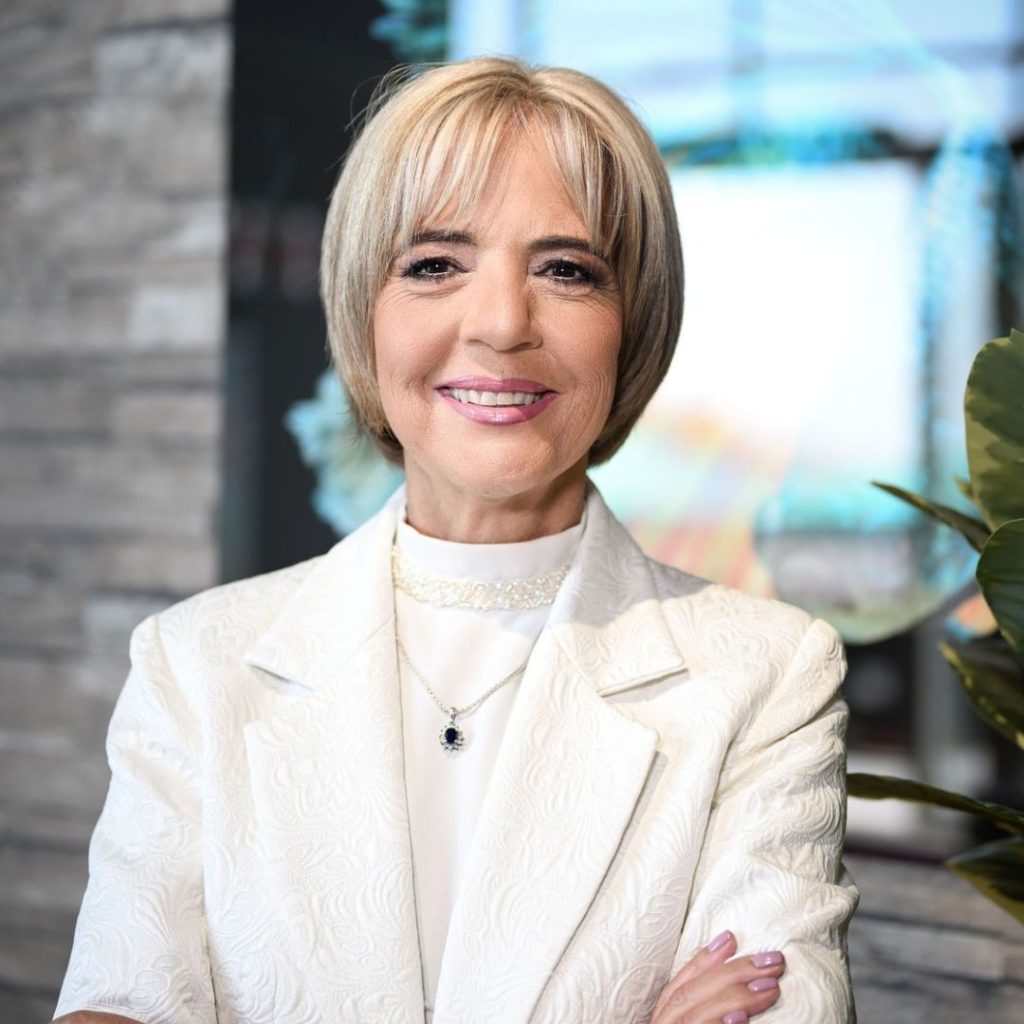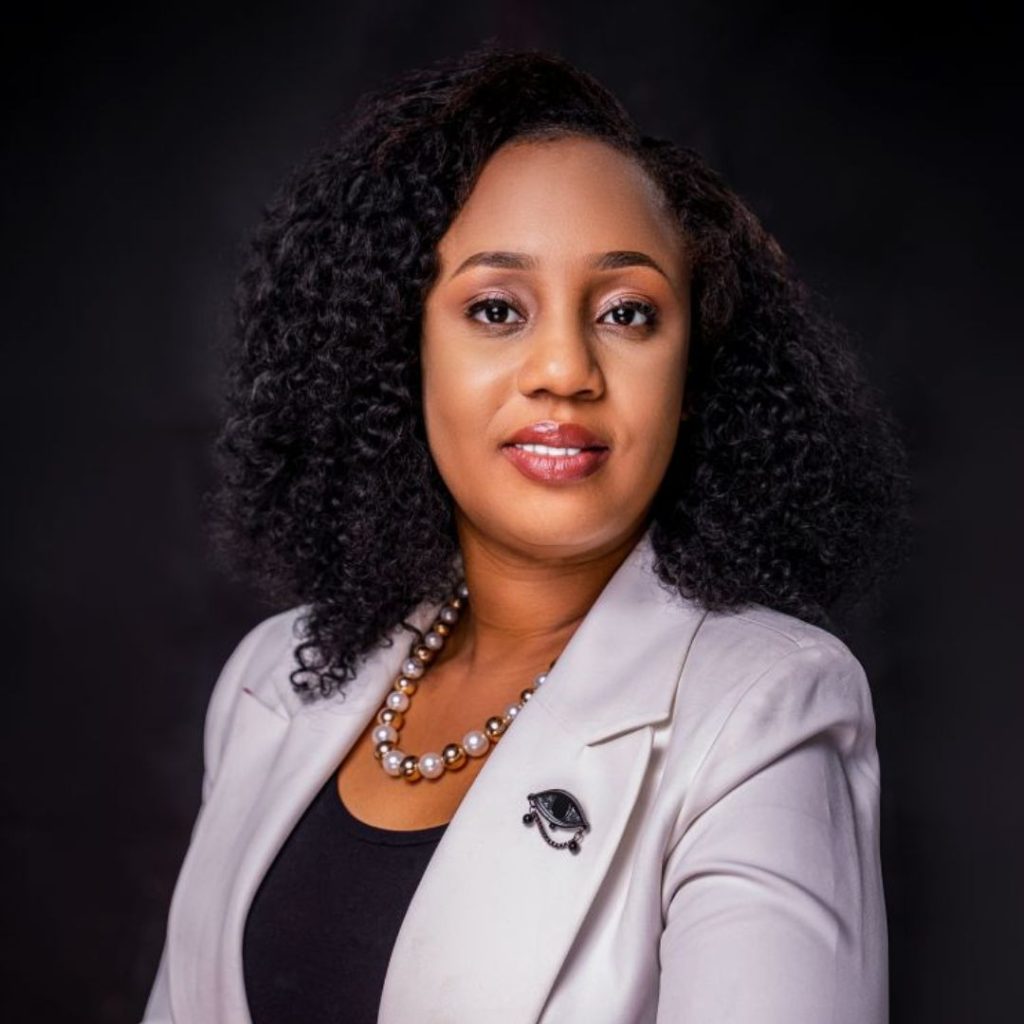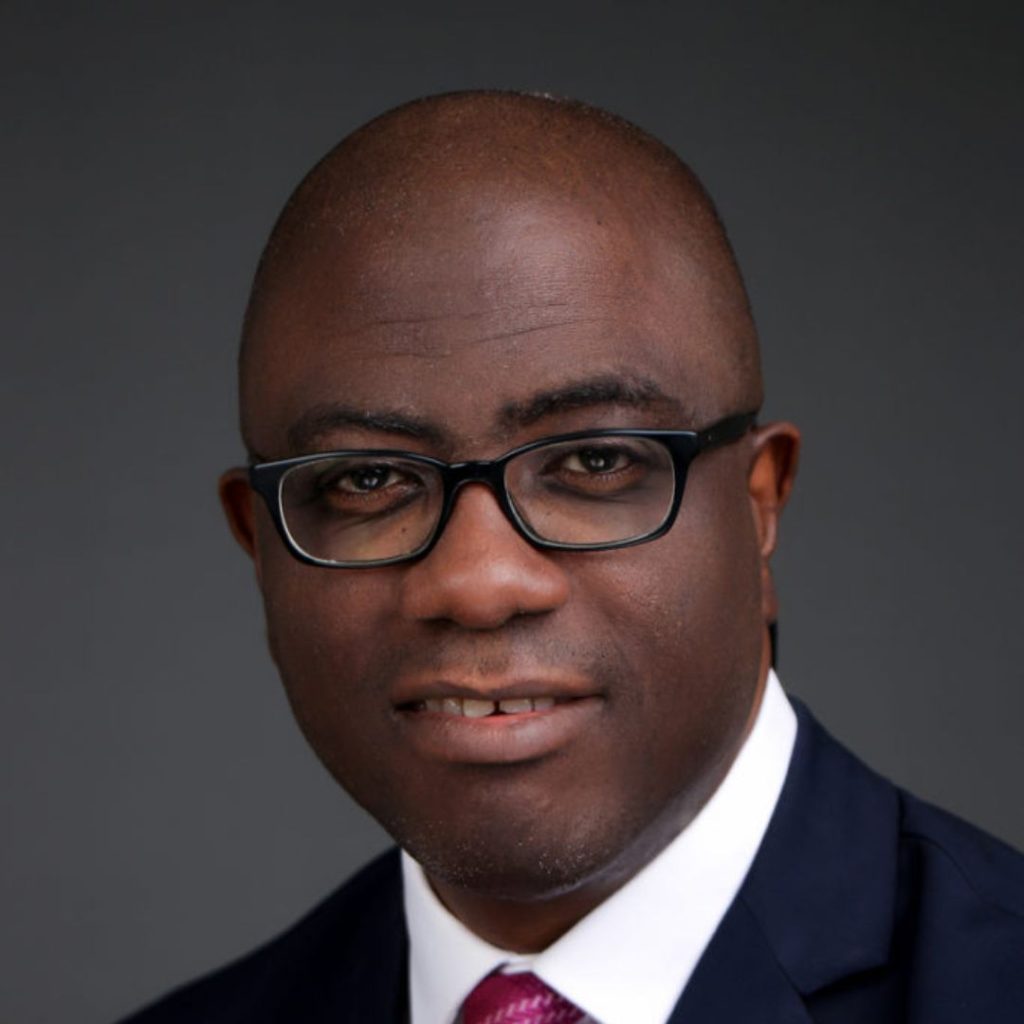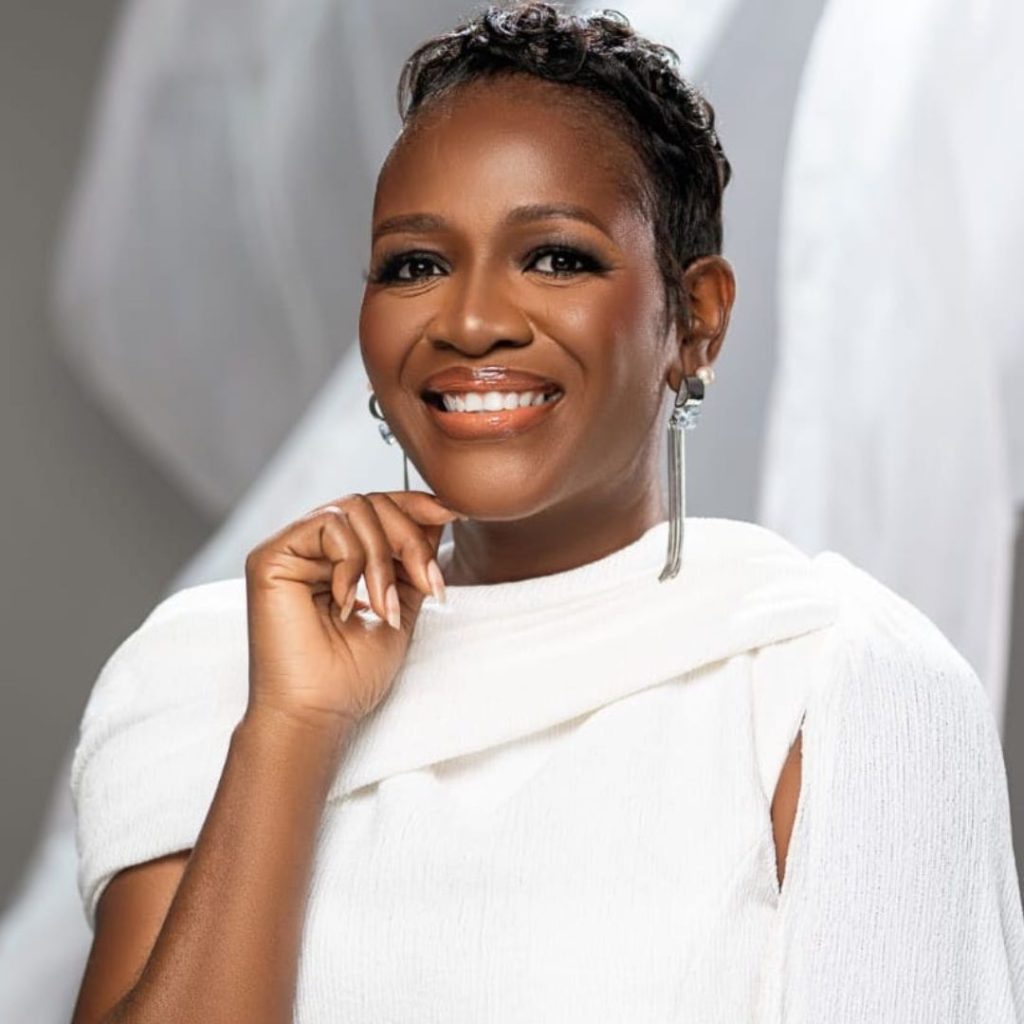
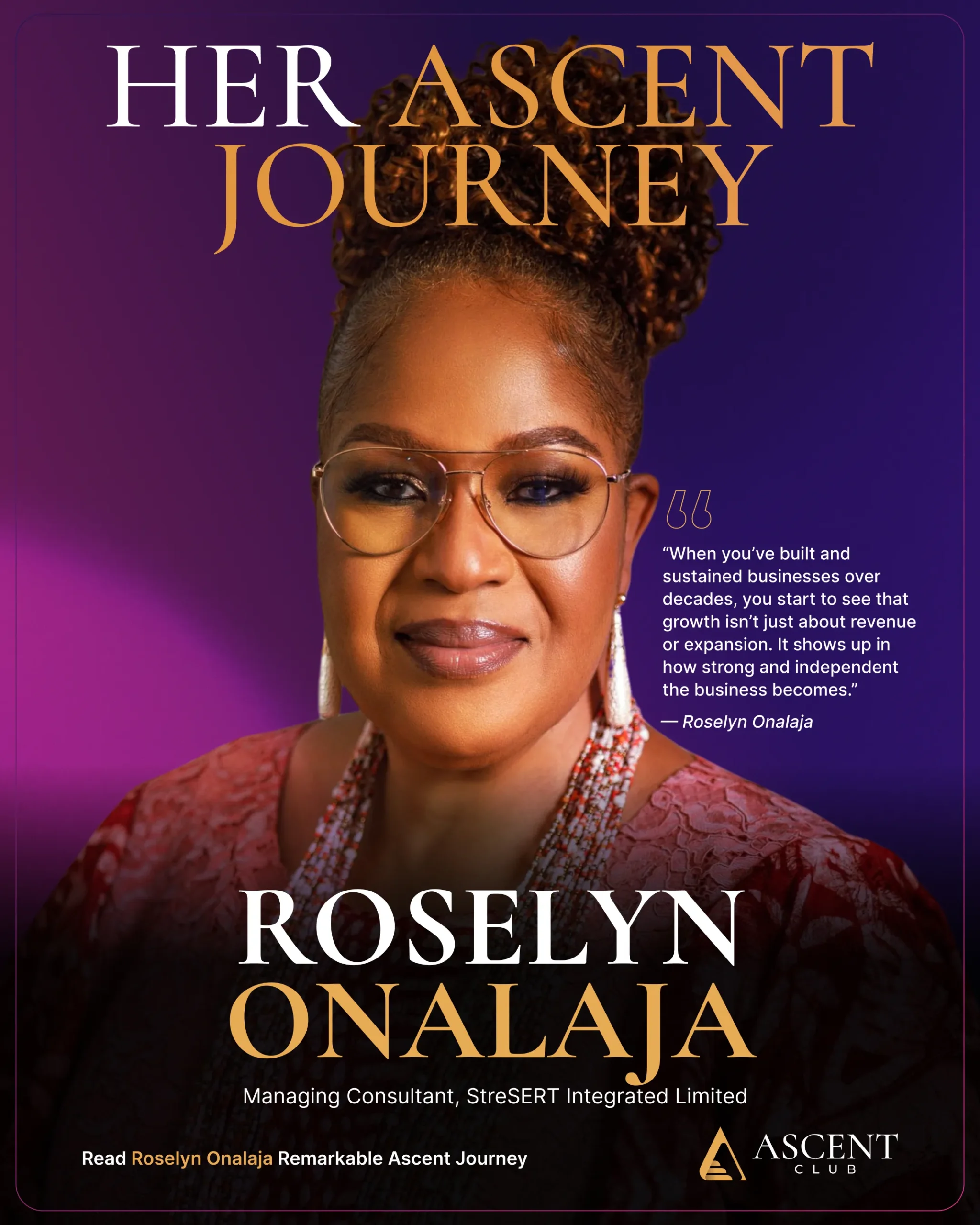
“When you’ve built and sustained businesses over decades, you start to see that growth isn’t just about revenue or expansion. It shows up in how strong and independent the business becomes.” — Roselyn Onalaja
Featuring: Roselyn Onalaja, Managing Consultant, StreSERT Integrated Limited
Roselyn Onalaja is a management and HR consultant with nearly two decades of entrepreneurial experience, focused on helping early-stage businesses grow into profitable, sustainable organisations. After a decade in consulting, she went on to build and lead her own firm, where she advises, coaches, and mentors leaders across industries.
Her expertise spans people and organisational development, leadership growth, and building resilient, people-first cultures within the SME ecosystem. Roselyn has played a key role in developing leadership pipelines and supporting founders through critical growth and transition phases, including succession planning.
A recipient of the Model Entrepreneur Award, she has founded and sustained two businesses over nearly two decades. She also serves on the boards of two logistics companies, contributing her governance and HR expertise. Roselyn holds degrees in Linguistics and Public Administration, is an alumna of the Lagos Business School Owner Manager Programme, and is a certified John Maxwell and life coach, known for her practical, people-centred approach.
In this edition of Her Ascent Journey, Roselyn Onalaja reflects on what it truly takes to build businesses that last beyond the founder. Her perspective brings a grounded look at structure, governance, and the often-avoided decisions that determine whether a business scales sustainably or stays stuck in cycles of effort without progress.
From your experience coaching founders and leaders, what are the most common blind spots that limit team performance and growth?
“When working with founders and leaders, the real blind spots are rarely about ability. They tend to sit in gaps around clarity, alignment, and everyday leadership behaviour. Many leaders believe they’ve communicated well, but teams are often operating with different interpretations of priorities and what success looks like. Add to that an over-reliance on the founder for decisions, underdeveloped middle management, and a tendency to avoid difficult conversations, and you start to see why performance stalls.
There’s also the issue of structure. Incentives don’t always align, accountability is often loose, and execution systems are either unclear or inconsistent. So teams stay busy, but not necessarily effective.
Then there are the deeper, less obvious gaps. Culture is shaped by what leaders allow, not what they say. Hiring decisions sometimes favour familiarity over long-term fit, and limited self-awareness at the top can quietly erode trust. Over time, leaders get pulled into daily demands, lose touch with customers, and delay succession planning. At that point, growth isn’t about effort anymore. It’s about what hasn’t been addressed yet.”
You’ve worked extensively with SMEs building from the ground up. What does a strong organisational foundation look like in the early stages of a business?
“A strong organisational foundation in the early stages of an SME doesn’t come from complexity. It comes from clarity, discipline, and being intentional about structure. That starts with a clear vision translated into a few focused priorities, well-defined roles, and simple performance expectations that people can actually measure and work toward.
At some point, the founder also has to step back from doing everything and start enabling others. That looks like trusting people with responsibility, creating regular communication rhythms, and investing early in developing emerging leaders, especially middle managers. It’s not a perfect process, but it’s a necessary shift.
Then there are the basics that quietly hold everything together. Financial discipline, hiring people who fit both the role and the culture, and building a culture through consistent behaviour, not slogans. When these pieces are in place, the business is not just running. It is set up to grow without being entirely dependent on the founder.”
Many SMEs overlook governance until issues arise. What are the early governance frameworks you believe are non-negotiable for long-term sustainability?
“Many SMEs delay governance because they think it means complexity. In reality, the early foundations are simple and make all the difference long term. It starts with clarity. Even if one person is both owner and operator, there should be a clear distinction between those roles, with defined decision rights and accountability. Basic financial discipline is also non-negotiable. Clean records, budgeting, cash flow visibility, and regular reviews, supported by simple controls that reduce errors and misuse.
Beyond that, there needs to be some structure around performance. Clear goals, regular check-ins, and a system where results actually connect to consequences and rewards. Without that, it’s easy for activity to replace progress.
Then comes rhythm and oversight. Structured leadership meetings, documented decisions, and clear reporting lines create consistency. Bringing in early external perspective, whether through an advisory board or experienced mentors, helps challenge thinking before issues escalate. Culture also plays a role here. Values should be clear and visible in how decisions are made, supported by simple guidelines around ethics and risk. And even at this stage, thinking about succession matters. It reduces dependence on one person and sets the business up to grow without unnecessary disruption.”
Having built and sustained businesses over nearly two decades, what does sustainable growth look like beyond revenue and expansion?
“When you’ve built and sustained businesses over decades, you do start to see that growth isn’t just about revenue or expansion. It shows up in how strong and independent the business becomes. A business that can run without the founder at the centre of every decision. One with capable leaders who can think, act, and deliver without constant supervision.
You also see it in how the business operates day to day. Consistent execution. Solid governance. Healthy cash flow. Systems that don’t break as things grow. And a culture that isn’t just written somewhere, but actually lived. Where accountability is normal and performance is both expected and supported.
Then there’s the external side. Strong relationships with customers, employees, and stakeholders. Trust that’s been built over time. A reputation that holds up. Sustainable growth beyond revenue and expansion means the business can adapt without losing direction, evolve without becoming unstable, and keep developing people who can carry it forward. At that point, it’s not just growing but built to last, with or without the founder in the room.”
What important conversations around leadership, people, or governance do you believe are still not happening enough within the SME space?
“In the SME space, the conversations that matter most are often the ones people avoid because they feel uncomfortable, premature, or “too corporate.” But they’re usually the difference between a business that grows and one that stalls. One of the biggest gaps is around the founder’s evolution. When do you stop being the operator? What do you let go of? And are you, or your team, actually equipped for the next stage?
Then there’s the talent conversation. Being honest about whether the right people are in the right roles, addressing underperformance early, and making tough calls to upgrade capability instead of defaulting to loyalty. There is also not enough dialogue around real accountability and governance — moving beyond informal decision-making to clear structures, defined authority, and disciplined follow-through. Many SMEs avoid discussing power, decision rights, and transparency until conflict forces the issue.
Culture is another one. It’s often talked about in ideals, not in behaviour. What’s actually being rewarded? What’s being ignored? And then there’s succession and continuity, which gets pushed aside until it becomes urgent, leaving organisations exposed to key-person risk. Ultimately, the conversations that are missing are the ones that require leaders to confront reality — about themselves, their people, and their systems — and to intentionally build a business that can perform and endure beyond them.”
As a governance-focused leader and board contributor, how has being part of Ascent Club strengthened your positioning for board roles, expanded your influence, or opened up high-level advisory opportunities?
“Being part of a platform like Ascent Club goes beyond participation. It gives you a space to position yourself intentionally as a boardroom asset with a clear point of view. At this level, what sets you apart is knowing exactly where you create the most value. Whether it’s governance transformation in SMEs, leadership and culture alignment, or scaling through strong people systems, the focus shifts from being broadly experienced to being known for something specific. That means being deliberate about how you communicate your impact, how you show up in conversations, and how your profile and contributions consistently reinforce that positioning.
It also shapes how you build visibility and influence. The quality of conversations matters. Engaging in discussions around governance gaps, CEO effectiveness, succession, and accountability creates space for your voice to stand out. Contributing to thought leadership, mentoring others, and participating in problem-solving conversations that reflect real boardroom dynamics all strengthen credibility. At the same time, relationships become a key lever. Building trust with other experienced leaders and decision-makers within the network often opens doors that formal applications don’t.
Beyond visibility, Ascent pushes you to demonstrate readiness in practice. Deepening your understanding of financial oversight, risk, and strategy, staying current on governance trends, and showing that you can both support and challenge leadership when needed. Over time, you become known for bringing clarity to complex issues, asking the questions others avoid, and driving accountability without stepping into operations. That’s where the shift happens. You move from being just a qualified candidate to a valuable voice in governance and leadership spaces.”
Conclusion
Roselyn Onalaja’s ascent reflects a clear commitment to building businesses that can function beyond the founder. Her work pushes leaders to move from hands-on control to intentional structure, stronger systems, and real accountability. Over time, that shift changes everything. The business becomes more stable, more resilient, and far less dependent on one person to keep it moving.
Her Ascent Journey is powered by Ascent Club, the premier visibility platform for African and diaspora women who are C-suite, board- and speaker-ready. Through curated storytelling, media amplification and strategic positioning, we elevate the expertise of our members so they are not only seen but sought after for the world’s most influential tables.
Are you a senior female leader ready to amplify your thought leadership, secure speaking engagements or position yourself for board opportunities? Ascent Club is your launchpad to global influence.