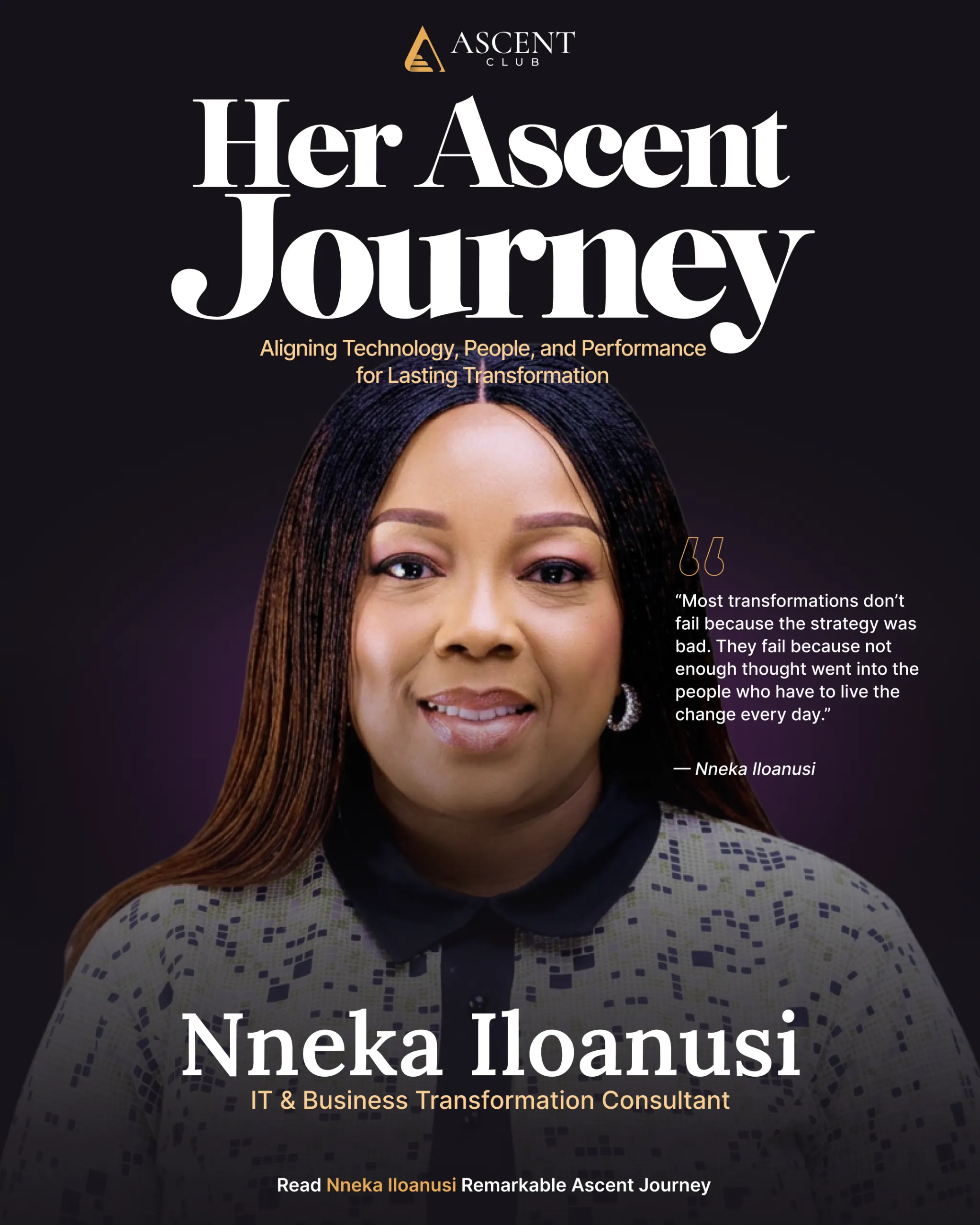
“Most transformations don’t fail because the strategy was bad. They fail because not enough thought went into the people who have to live the change every day.”— Nneka Iloanusi
Featuring: Nneka Iloanusi, IT & Business Transformation Consultant
Nneka Iloanusi is a technology and business improvement executive with over 22 years of leadership experience in IT service delivery, digital transformation, and operational governance within the oil and gas industry. She has led enterprise-wide initiatives that align digital strategy with business objectives, driving efficiency, transparency, and sustained value creation across complex operations.
With a strong foundation in production systems, project management, and process optimisation, Nneka brings a board-relevant perspective on strategy execution, risk management, and change leadership. She has delivered large-scale transformation programmes, including digital initiatives that improved data integrity and system reliability, reduced downtime, and accelerated decision-making, as well as enterprise optimisation efforts that delivered over $2 million in operational savings.
Known for bridging technology and operational delivery, she has implemented governance frameworks, embedded performance-driven cultures, and aligned cross-functional teams around measurable outcomes. Nneka is focused on contributing this expertise at board level, offering practical insight into digital transformation, execution discipline, and innovation in regulated industries.
In this edition of Her Ascent Journey, Nneka shares why successful digital transformation has far less to do with technology than most organisations believe. Drawing on more than two decades of leading enterprise-wide transformation programmes, she explores the leadership, governance, and execution disciplines that turn digital ambition into measurable business performance, while offering practical insights for boards and executives navigating change in complex organisations.
Many organizations invest heavily in digital transformation without seeing real impact. From your experience, what separates transformation that delivers value from transformation that stalls?
“In my experience, the difference between digital transformation that delivers value and the kind that quietly stalls comes down to one thing: clarity. Did the organisation clearly define the problem it was solving, or did it simply buy technology and hope the value would follow?
The transformations that create real impact are rarely about the technology itself. They focus on improving the underlying process, creating better visibility into data, removing friction from the customer experience, and eliminating operational inefficiencies. When that happens, the results are tangible: faster decisions, lower costs, and better use of resources. Technology enables those outcomes, but it doesn’t create them on its own.
Ownership matters just as much. I’ve seen initiatives struggle because they were driven entirely by IT and then handed to the business to adopt. The most successful transformations work the other way around. Business leaders own the agenda, while technology plays the role of enabler. People are also far more committed to change when they’ve helped shape it, rather than having it imposed on them.
Finally, organisations that sustain results are disciplined about measuring progress. They focus on a few meaningful indicators that allow leadership and the board to see whether the investment is delivering real efficiency, growth, or profitability.
If I had to sum it up in one sentence, it would be this: the organisations that succeed treat transformation as a business initiative enabled by technology, not a technology initiative the business is expected to adopt. When strategy, people, process, and technology move in the same direction, transformation stops being a project and becomes part of how the organisation performs.”
How do leaders sustain performance improvements across teams without creating fatigue or resistance?
“Sustaining performance gains without wearing people out is mostly a pacing problem disguised as a culture problem. In most cases, people aren’t exhausted by one major change. They’re exhausted by multiple initiatives arriving at the same time, each competing for attention. The first discipline, therefore, is restraint. Fewer priorities, executed well, will always outperform a long list of competing ones.
Leaders also need to help people see progress. Small, visible wins do more for morale than any launch campaign because they prove the effort is working. When people can see results, they’re far more willing to stay engaged through the difficult parts of change.
Ownership matters too. Teams that are simply told what to do may comply, but teams that have a genuine voice in how change is implemented are much more likely to sustain it. People support what they help create.
Burnout also has to be treated as a leading indicator, not something you notice after someone quits. That means paying attention to workload as closely as outcomes and being willing to slow down or reprioritise when the pace becomes unsustainable.
Ultimately, the improvements that last are the ones that stop feeling like a special initiative and simply become part of how the organisation operates. The goal isn’t to maintain constant intensity. It’s to embed new behaviours until they become the normal way of working.”
Transformation often fails at the human level. How do you align people, culture, and incentives to support lasting organisational change?
“Most transformations don’t fail because the strategy was bad. They fail because not enough thought went into the people who have to live the change every day. What are they worried about losing? Are the new behaviours genuinely rewarded, or just talked about? And have they actually been shown how to work differently?
It starts with honest communication. People rarely resist change itself. They resist uncertainty. When leaders explain why the change is happening, keep people informed as it unfolds, and are open about the challenges along the way, trust grows.
Incentives matter just as much. Organisations often say they value innovation or customer focus, but people pay far more attention to what gets recognised and rewarded. If promotions and recognition don’t reflect the behaviours you’re asking for, the old habits will always win.
People are also far more likely to support change when they help shape it, rather than having it handed to them. That sense of ownership makes a real difference.
And finally, build capability. You can’t expect people to work differently without giving them the skills, support, and time to practise. Lasting transformation happens when people understand the purpose, feel part of the process, and are equipped to succeed.”
With your experience in embedding governance frameworks and KPIs, what should boards prioritize when strengthening performance oversight?
“In my experience, boards often drown in performance packs full of metrics and still leave the room no clearer on whether the strategy is actually working. The real job isn’t reviewing more data. It’s having the discipline to focus on the handful of KPIs that genuinely show whether the organisation is delivering on its priorities. If a board can’t identify the three or four measures that matter most, it’s usually a sign the reporting has become more complex than the thinking behind it.
Data quality matters just as much. A dashboard is only as useful as the information behind it. Boards should be willing to ask not only what the numbers say, but how they were produced. That level of scrutiny often uncovers issues before they become bigger problems.
Accountability is equally important. Every key metric should have a clear owner who can explain the results, what’s driving them, and what actions are being taken. Without that, the same issues simply get carried from one board meeting to the next.
Finally, performance oversight should never become a compliance exercise. The strongest boards create an environment where difficult questions are welcomed, constructive challenge is encouraged, and reporting becomes a tool for better decision-making rather than a ritual of simply presenting numbers.”
You’re a leader driving digital and operational transformation, what core message would you bring to a global audience on aligning technology, people, and performance?
“My message to a global audience is simple: the hardest part of digital transformation has never been the technology. It’s closing the gap between strategy and execution.
Technology only creates value when it’s tied to a clear business outcome, supported by people who are equipped to work differently, and reinforced by performance measures that reward the right behaviours. Too often, organisations invest in new platforms while overlooking the changes to processes, skills, and accountability that ultimately determine success.
When technology, people, and performance are genuinely aligned, transformation stops being a one-off initiative and becomes part of how the organisation operates. That’s when you see faster decisions, stronger productivity, and results that endure long after implementation.
Technology is the enabler. People drive the change. Execution is what turns transformation into lasting business value.”
As a digital transformation and business improvement leader with deep operational insight, how has being part of Ascent Club supported your visibility, influence, or positioning for board and advisory opportunities?
“Being part of Ascent Club has genuinely changed the trajectory of my growth as a transformation leader. It’s not just another network you join and quietly forget about. It’s a community of women who’ve done the work and are willing to have honest, sometimes uncomfortable conversations about what it really takes to lead change at scale and be recognised for it.
What I’ve gained most isn’t a list of contacts. It’s perspective and confidence. The conversations and curriculum have helped me translate years of operational experience into strategic influence. They’ve changed how I show up in advisory settings and challenged me to think more deeply about the connection between technology, performance, and purpose. I’ve come to believe that real impact comes from combining strategic insight with hands-on operational experience.
Perhaps most importantly, Ascent Club has strengthened my credibility as a leader. Being surrounded by women who value authenticity as much as execution has sharpened my thinking, expanded my perspective, and given me greater confidence to contribute in boardroom and advisory conversations. It’s a well-structured community that has made a meaningful difference to my leadership journey.”
Conclusion
Nneka Iloanusi’s ascent has never been about keeping pace with technology. It has been about helping organisations use it with purpose. By bringing together strategy, governance, people, and execution, she continues to show that the organisations best prepared for the future are those that understand transformation as a leadership challenge first, and a technology challenge second.
Her Ascent Journey is powered by Ascent Club, the premier visibility platform for African and diaspora women who are C-suite, board- and speaker-ready. Through curated storytelling, media amplification and strategic positioning, we elevate the expertise of our members so they are not only seen but sought after for the world’s most influential tables.
Are you a senior female leader ready to amplify your thought leadership, secure speaking engagements or position yourself for board opportunities? Ascent Club is your launchpad to global influence.