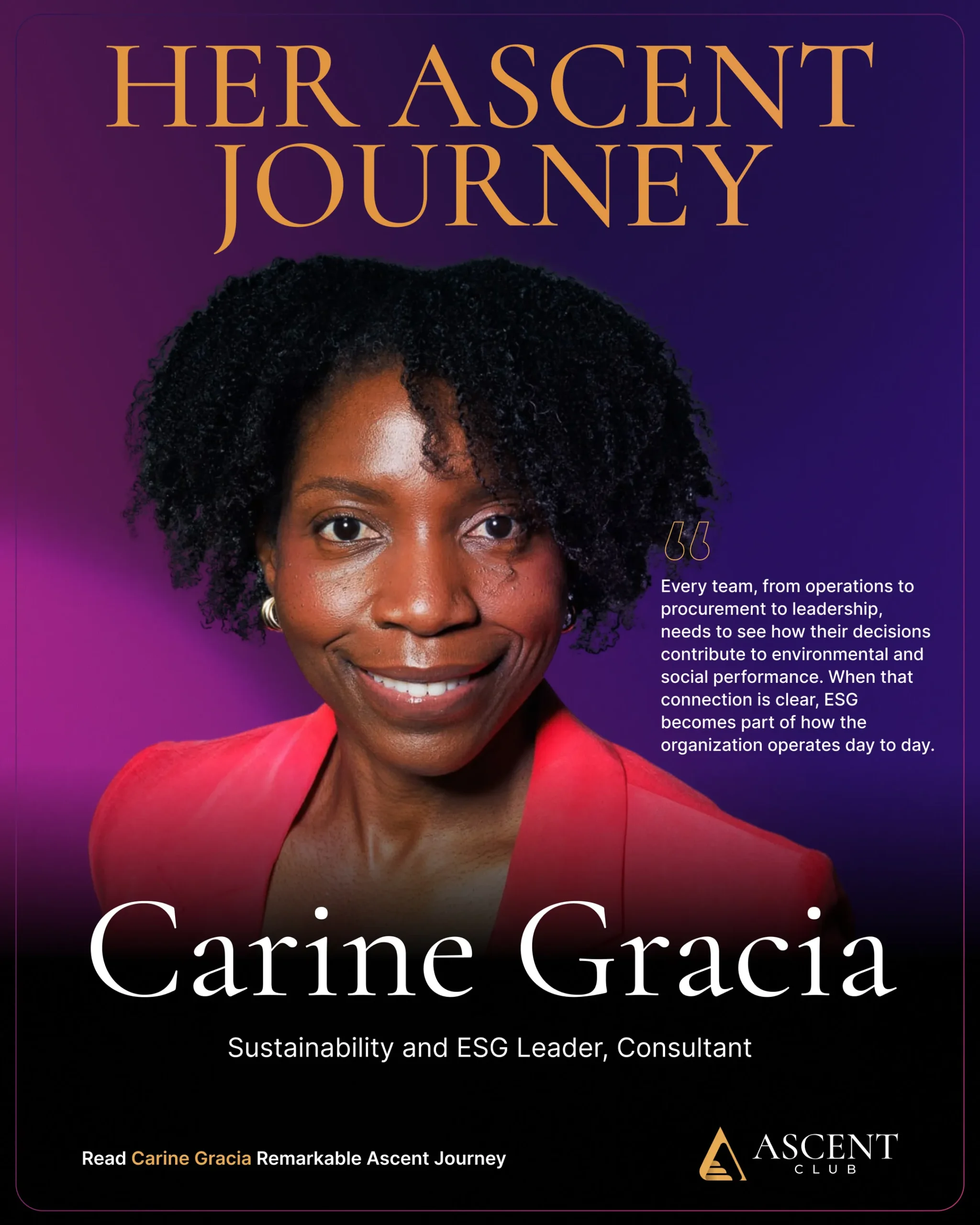
Featuring: Carine Gracia, Sustainability and ESG Leader, Consultant, France
“Every team, from operations to procurement to leadership, needs to see how their decisions contribute to environmental and social performance. When that connection is clear, ESG becomes part of how the organization operates day to day.”— Carine Gracia
Carine Gracia is a strategic ESG and Social Performance leader with 20 years of experience in sustainability, stakeholder engagement, and corporate communications across Europe and Africa. Her work spans the finance and mining sectors, where she has led social performance strategies in complex and fragile environments, aligning operations with global standards including IFC Performance Standards and the Aluminium Stewardship Initiative.
Her specialty lies in designing and executing ESG and social performance frameworks that deliver measurable value for communities and organisations. At Compagnie des Bauxites de Guinée (CBG), Carine built the Communities and Social Performance department from the ground up, leading compliance across land acquisition, resettlement, cultural heritage, and stakeholder engagement, while driving youth and women economic empowerment programmes impacting over 1,000 people and supporting thousands of local jobs.
Earlier in her career, she led communications for major multinationals, including Rio Tinto’s
Simandou project. She also served as an investment committee advisor for an impact fund in Senegal.
In this edition of Her Ascent Journey, Carine shares how she turns ESG principles into operational impact across complex and fragile African environments, builds resilient teams and develops governance systems that create long-term value. She reflects on empowering communities and mentoring the next generation of ESG leaders to shape a more responsible and sustainable future.
You’ve led ESG strategy across fragile and complex environments. What distinguishes a compliance-driven ESG approach from a strategy that genuinely creates long-term value? “In my experience, the key difference lies in how ESG is positioned within the organization. A compliance-driven approach focuses on meeting external requirements such as reporting, standards, and audits, and is often treated as a parallel exercise to the core business.
A strategy that creates long-term value is different because it requires ESG to be understood and embraced across the organization. Every team, from operations to procurement to leadership, needs to see how their decisions contribute to environmental and social performance. When that connection is clear, ESG becomes part of how the organization operates day to day. This is often a maturity journey, moving from understanding to adoption and full integration into decision-making.
In complex environments such as the extractive sector, ESG must translate into real operational systems. That includes credible stakeholder engagement, well-structured resettlement processes, effective livelihood restoration programs, responsible resource management, biodiversity protection, and strong governance mechanisms that build trust with communities, governments, and financiers.
That is what ultimately distinguishes ESG that is done for compliance from ESG that drives long-term value.”
Mining projects often operate at the point where economic opportunity and social tension meet. How can sustainability strategies balance national development goals with community trust?
“Mining projects can be powerful engines of national development, but they also operate very close to people’s land, livelihoods, and expectations. From my experience, sustainability strategies work when they recognize both realities. It’s about delivering economic value at the national level while ensuring that communities closest to the project see tangible, credible benefits.
In practice, this means investing in local economies, supporting small businesses, strengthening supplier capabilities, improving access to finance, and developing sustainable livelihoods beyond the mine itself. It also means protecting natural resources, restoring land and biodiversity, and ensuring that landscapes remain productive for the communities that depend on them. In some cases, rehabilitation efforts can even support new livelihood opportunities over time.
Trust is built when communities feel respected, included, and able to see that mining activities do more than extract value. They should strengthen local economies, protect ecosystems, and create opportunities that last beyond the life of the project. This requires a participatory, co-development approach that responds to local needs and aspirations.”
As sustainability expectations evolve, what capabilities should the next generation of ESG leaders in Africa be intentionally developing today, and how do you approach succession planning within your teams?
“The next generation of ESG leaders in Africa needs a combination of three things: strong technical grounding, operational understanding, and strategic influence.
On strong technical grounding, they need a solid grasp of global ESG frameworks and standards, but more importantly, the ability to translate those into credible action on the ground. In many African contexts, that means navigating complex social dynamics, environmental realities, and evolving regulatory expectations.
On operational understanding, they need to operate confidently in that complexity, engaging with lenders, financiers, and multiple stakeholders, while building expertise in areas like climate, carbon, and supply chains.
On strategic influence, beyond technical capability, ESG leaders must operate at a strategic level. They need to integrate ESG into core business strategy and contribute meaningfully to executive-level discussions, ensuring environmental and social considerations are embedded in decision-making, risk management, and long-term value creation.
Regarding succession planning, I’ve always placed strong emphasis on mentoring, coaching, and developing talent within my teams. That includes delegating responsibility, building trust, and creating opportunities for exposure through committees, audits, and industry forums. These experiences help develop judgment and perspective. The goal is to build resilient teams where individuals continue to learn, take ownership, and grow into leadership roles.”
The extractive sector has historically been male dominated. How has being a woman shaped your leadership approach, negotiations, and influence within executive and governmental spaces?
“I don’t frame my approach as a “female leadership style.” For me, it has always been about building credibility through expertise, preparation, and delivering tangible results. I invest time in fully understanding the subject, the context, and the expectations of each stakeholder. In complex environments, especially when engaging with executives, governments, or financiers, that level of preparation is the foundation for influence.
I also pay close attention to the dynamics in the room, what matters to different stakeholders, what drives decisions, both formally and informally. Emotional intelligence plays a key role here, being able to listen carefully, read the room, and understand different perspectives helps move discussions forward constructively. At the same time, staying authentic and grounded in my values has been critical in building long-term trust and credibility.
Finally, leadership is never individual. I rely strongly on my team and on trusted internal allies, including operational leaders. Building that internal alignment is often what makes external negotiations and engagements successful.”
What legacy do you hope to leave in shaping ESG governance and social performance leadership across Africa?
“If I reflect on the legacy I hope to contribute, it is helping to move ESG governance in Africa from principle to practice. Throughout my career, particularly in the mining sector, I’ve focused on translating global environmental and social standards into operational systems that work on the ground, especially in complex and fragile environments. For me, strong ESG governance goes beyond frameworks and reporting. It is about building credible systems that strengthen trust between companies, communities, governments, and investors, while supporting long-term development.
Another important aspect is embedding ESG into business decision-making more broadly, not only in large multinational companies, but also in local businesses and SMEs, in ways that are practical and adapted to their reality. Even small steps can be meaningful. At that level, ESG becomes a governance framework that helps manage risk, create long-term value, and shape how companies operate.
Legacy, for me, is also about people. Africa has an extraordinary generation of young professionals entering the ESG space, and supporting them is essential. Through initiatives like the recently concluded Reset Summit by 9to5Chick where I had the opportunity of mentoring alongside other outstanding executive women, I aim to help transfer knowledge, strengthen leadership, and inspire the next generation to see sustainability as a driver of transformation. If I can contribute to stronger governance, more responsible businesses, and empowered future leaders, then I believe I’ve played a meaningful role in advancing sustainable development across the continent.”
As a leader operating at the intersection of ESG, community development, and investment decision-making, how has being part of Ascent Club supported your visibility, influence, or positioning for advisory and board-level opportunities?
“As I enter a new chapter in my career, being part of Ascent Club has been both clarifying and transformative. For many years, my visibility was closely linked to the roles I held. Ascent helped me realize that true executive positioning cannot depend on a title. It has to be grounded in expertise, value creation, and the impact I bring. It supported me in structuring my visibility around my core strengths and being more intentional about how I show up.
It also pushed me to think more deliberately about board-level opportunities, the types of organizations and sectors I want to contribute to, and how to prepare for that level of responsibility. The exposure to high-level conversations with senior executives and board members has been invaluable, offering practical insight into positioning, readiness, and navigating board dynamics. Overall, I would say it has elevated my perspective, sharpened my strategic thinking, and reinforced a long-term approach to influence and governance.”
Conclusion
Carine Gracia’s ascent reflects a leadership style rooted in credibility, discipline, and long-term impact. Across complex and fragile environments, she has shown that ESG is not just a compliance exercise but a strategic lever for communities, organizations, and national development. As she steps further into board and advisory roles, she represents and advocates for a new kind of leadership, one that understands that sustainable growth, strong governance, and inclusive development are not competing priorities, but part of the same equation.
Her Ascent Journey is powered by Ascent Club, the premier visibility platform for African and diaspora women who are C-suite, board- and speaker-ready. Through curated storytelling, media amplification and strategic positioning, we elevate the expertise of our members so they are not only seen but sought after for the world’s most influential tables.
Are you a senior female leader ready to amplify your thought leadership, secure speaking engagements or position yourself for board opportunities? Ascent Club is your launchpad to global influence.