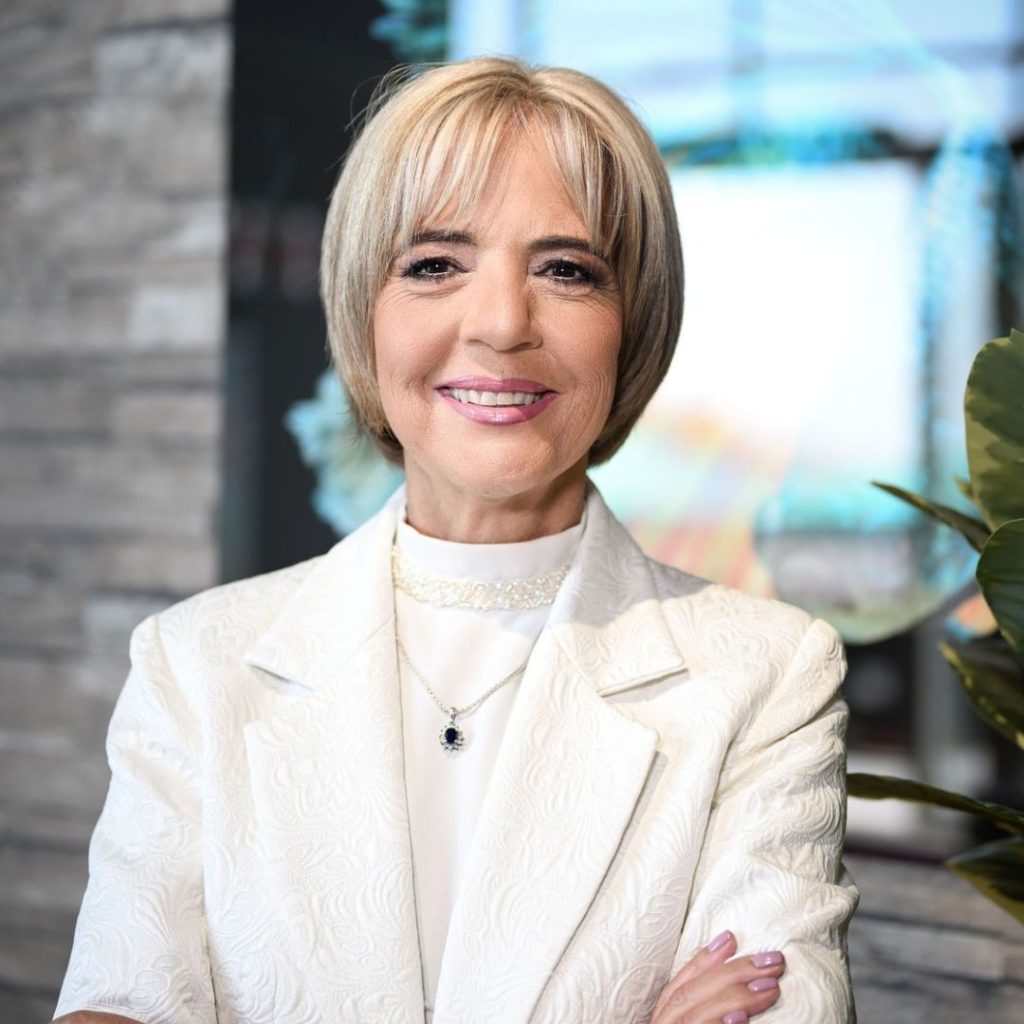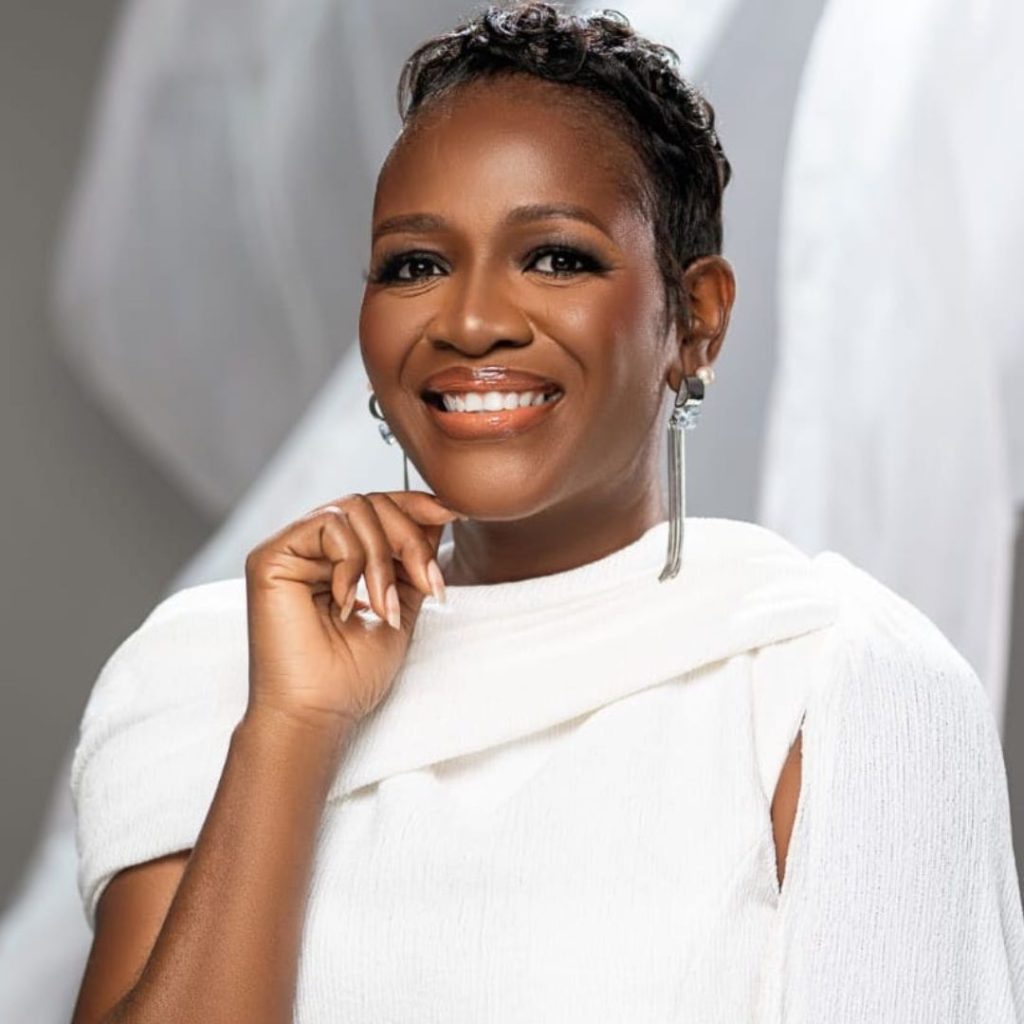
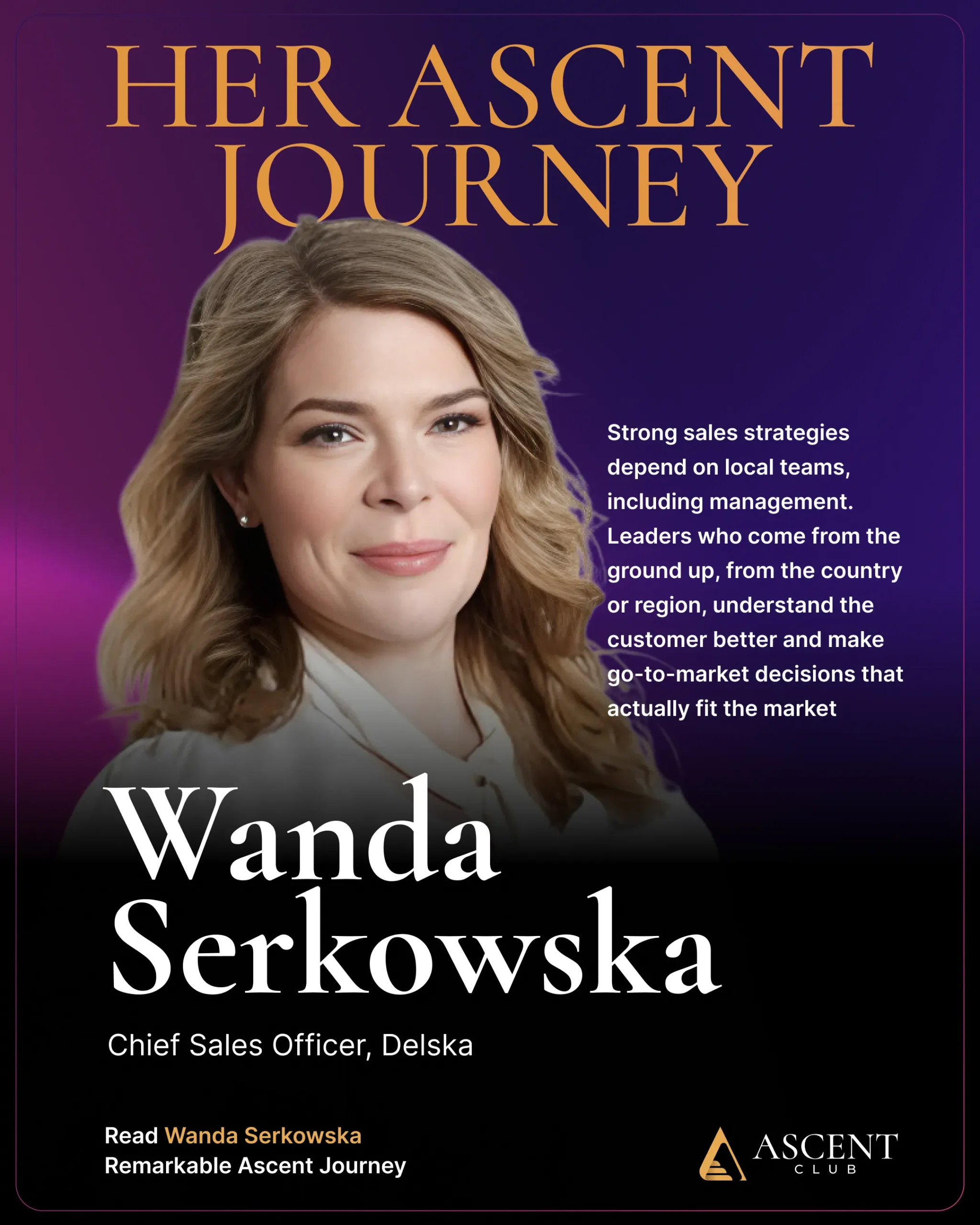
Featuring: Wanda Serkowska, Chief Sales Officer, Delska.
“Strong sales strategies depend on local teams, including management. Leaders who come from the ground up, from the country or region, understand the customer better and make go-to-market decisions that actually fit the market.” — Wanda Serkowska
Wanda Serkowska is a multilingual sales and commercial leader with over 15 years of experience driving growth and strategic partnerships across telecom, data center, and network technology. She specialises in data center colocation, internet exchange, and cloud access solutions, with a strong track record of aligning commercial strategy with long-term business value.
Her career spans Sub-Saharan Africa, the Middle East, and Europe. While at Ericsson, she managed and sold to major telecom operators including MTN and Airtel across Côte d’Ivoire, the DRC, Congo Brazzaville, and Benin Republic. Known for her strength in senior stakeholder management, Wanda is a trusted adviser to senior decision-makers and C-suite leaders across complex, multi-market environments.
With a background in Management Accounting and Finance and a CIMA certification, she approaches every deal through both a commercial and CFO lens. Currently supporting network customers across 19 countries in the EMEA region, Wanda is guided by one clear principle: build for the long term.
In this edition of Her Ascent Journey, Wanda shares how she builds and scales digital infrastructure across complex global markets, adapts commercial strategy to local realities, and approaches growth with a long-term, board-level mindset.
You have worked across telecom, data centers, and now AI-adjacent infrastructure. What shifts are you seeing in how organisations think about digital infrastructure today compared to a decade ago?
“There has been a massive shift. Even as recently as three years ago, investment in digital infrastructure, AI agents, and related capabilities was still treated as optional. Today, it’s either a top priority or very high on the priority list.
What’s changed is the internal dynamic around investment. Spending on infrastructure and compute is now something executives know the board is likely to support. There’s a positive push to improve systems, modernize, and develop in that direction.
In the past, IT leaders had to fight for these investments. Every proposal came with heavy scrutiny and a requirement to demonstrate a very strict ROI. Over the last couple of years, that pressure eased significantly. At one point, it almost felt like everyone wanted to invest in AI.
There was, and probably still is, a bit of hype. But overall, this shift has been a good thing. These investments were needed anyway, and the reduced scrutiny has made it much easier for directors to move forward and build the infrastructure organizations actually require.”
You’ve led commercial growth across Africa, the Middle East, and Europe. What shifts when you’re building a sales strategy across markets with different regulatory, cultural, and maturity levels?
“Yeah, even from country to country, customer demand and behavior can be completely different, and that’s even more true across regions. Every market has its own strengths, gaps, and constraints, and sales strategy has to start from that reality.
In infrastructure, the differences are very clear. In Europe, for example, fiber and capacity services are relatively straightforward. Pricing is predictable, availability is good, and access isn’t a major hurdle.
In the Middle East, it’s much more complex. You need the right local partner, and you have to be careful. Services that are commodities in Europe can be very expensive, so negotiation and relationships matter a lot.
In Africa, it’s also different. Cost isn’t always the issue, but understanding which routes exist, where capacity is available, and who to partner with for subsea or fiber access is critical.
None of this is positive or negative. It’s just regional and often very local.
The other key shift is internal. Strong sales strategies depend on local teams, including management. Parachuting executives from headquarters rarely works. Leaders who come from the ground up, from the country or region, understand the customer better and make go-to-market decisions that actually fit the market.
Consumers in India, Nigeria, and Dubai behave very differently. Without local voices at every level, boards miss those differences. That local diversity of perspective is what makes cross-market sales strategies work.”
What has working across these regions taught you about designing solutions that scale without losing local relevance?
“I think one of the biggest lessons is around product development. You have to understand which products actually matter in a given region, and whether a solution that works well in one market is still strong and relevant in another. Many companies have failed by trying to replicate and scale the same offering everywhere without adapting it.
In some cases, the product simply wasn’t relevant locally. In others, the operational costs and complexity were so high that delivering the solution no longer made economic sense.
This goes back to leadership and how strategy is built. There has to be a top-down approach that actively listens bottom-up. Input from people on the ground and from middle management is essential to shaping one coherent strategy.
I’ve seen organizations do this very well, and I’ve also seen situations, including ones I’ve been part of, where there was clear room for improvement. In those cases, opportunities were missed because leadership wasn’t fully connected to local realities.”
Digital growth depends heavily on power and water resources. How should leaders in tech and infrastructure rethink sustainability as demand continues to rise?
“I think we’re already seeing that shift, and it’s a very positive one. Before the AI boom, sustainability wasn’t a real priority. Today, because AI applications and deployments require so much power, leaders are forced to think much more seriously about where that power comes from.
The same applies to water and other natural resources. We’re operating at a completely different scale. What used to be manageable has multiplied several times over, and that changes the conversation.
As a result, sustainability has become the only viable path forward. Power demand is now so significant that companies have to rethink where they build. Very often, the decision is to go where power and water are available, but to do so in partnership with local communities. The focus is no longer on extracting or exhausting resources, but on using them in a way that can last.
That long-term mindset is critical. Digital and AI infrastructure isn’t built for two or three years. It’s built for five, ten, even twenty years.
In that sense, sustainability is no longer optional or a box-ticking ESG exercise. Because of the scale of demand, it has become a necessity, and that’s a healthy shift for the industry.”
You are a recognised leader in digital infrastructure and commercial strategy. If you were to deliver a keynote to a global leadership audience, what would be your core message on building resilient, future-ready infrastructure in an AI-driven economy?
“This is something I feel very strongly about, and it’s still only partly understood. My core message would be that internet infrastructure, digital infrastructure, and AI are not just tools. They are fundamental drivers of economic growth at a national and regional level.
Expanding and scaling internet access enables businesses to grow, become reliable, and reach global customers. It allows people to find jobs, students to study, and entire ecosystems to form. The impact is enormous.
What still surprises me is that many governments and large public investors don’t fully connect the dots. Strengthening digital infrastructure is one of the fastest and most effective ways to grow GDP, especially compared to building new industries from the ground up, such as manufacturing. Every country already has some level of internet infrastructure. The opportunity is to improve it, expand it, and scale it with the right investment.
That investment can come through public funding, local capital, or partnerships with private companies. While the upfront capital requirements can be significant, the return is multiplied across the entire economy.
When digital infrastructure grows, everyone benefits. Not just companies, but every individual in the country. That’s the message I would want leaders to take away.”
As a board adviser and global commercial leader, how has being part of Ascent Club contributed to amplifying your visibility, expanding your influence, or positioning you for high-profile speaking and board opportunities?
“Being part of Ascent directly strengthened my executive visibility at a critical point in my career. It helped position me not just as an operator, but as a thought leader with my own platform. During my recruitment into my current role, that visibility mattered. My employer explicitly referenced the fact that I had my own table, a space where I convene conversations and contribute expertise beyond my role.
Ascent also accelerated my readiness for board work. Through its conversations, network, and exposure to board-level thinking, I became more intentional about governance, influence, and long-term impact. That led me to pursue and take on a trustee role, something I would not have actively considered without Ascent.
Beyond access, Ascent provided proximity to strong, board-ready women, executive coaching, and a mindset shift around leadership at the highest level. It didn’t just expand my network. It sharpened how I think, how I show up, and how I position myself for board and speaking opportunities.”
Conclusion
Wanda Serkowska’s ascent reflects a leadership philosophy grounded in scale, responsibility, and long-term value. Across markets and systems, her work shows that digital infrastructure is not a technical afterthought, but a strategic lever for economic growth, resilience, and inclusion. She challenges leaders to build beyond immediate returns, center local insight, and invest in systems that are designed to endure.
Her Ascent Journey is powered by Ascent Club, the premier visibility platform for African and diaspora women who are board- and speaker-ready. Through curated storytelling, media amplification and strategic positioning, we elevate the expertise of our members so they are not only seen but sought after for the world’s most influential tables.
Are you a senior female leader ready to amplify your thought leadership, secure speaking engagements or position yourself for board opportunities? Ascent Club is your launchpad to global influence.